


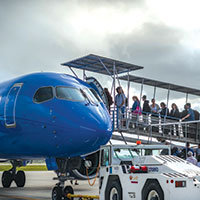
 Vero’s airline traffic far outstrips masterplan projections
STORY BY THOMAS A. KENNY (Week of April 23, 2026)
There’s been lots of chatter in Vero over the past year about how rapidly passenger service at the airport has increased, with real estate brokers up and down the island saying regular direct flights to destinations in the northeast have given the property market an exhilarating boost.
But the chatter doesn’t capture the magnitude of the phenomenon, which was missed entirely by the city’s latest airport masterplan.
That 20-year plan, which was released in 2024, projected that the number of commercial airline passengers boarding planes at Vero Beach Regional Airport would creep up slowly, reaching 55,000 annually by 2043, the final year covered in the plan.
In fact, by 2025, just a year after the plan was signed off on, 130,000 passengers climbed mobile stairs to find their seats on flights departing from Vero Beach – two and half times the projected number for 2043.
The total number of passengers, those landing as well as those departing, was 43,760 in March, up from 5,900 just three years ago, shortly after Breeze Airways launched its operation here in February 2023.
Breeze’s business grew steadily over the next two years, as word of the service spread and Vero residents incorporated the airline into their travel plans.
As it gained confidence, Breeze added new destinations and flights. And then, over the past year and half, two new big-name carriers arrived at the once sleepy little airport – JetBlue in December 2025 and American in February 2026 – adding still more destinations.
Locals and northerners wanting to visit Vero have embraced the convenient new flights, zipping back and forth to New York, Connecticut, Rhode Island, Boston, and now Charlotte, North Carolina. More than 400 passenger planes landed at the airport in March, with another 398 scheduled for April.
“When an airline goes into a new airport and they do quite well, it opens the eyes of the competitors,” said Airport Director Todd Scher. “They want to get a piece of the market.”
The airport masterplan, which was finalized in late 2023 before being released in 2024, noted that passenger numbers were up 57 percent in the second year of Breeze’s service, but missed the coming explosion in airline traffic.
“In 2023, we had no way of knowing whether Breeze was even going to be successful – and they had the same philosophical mindset,” said Scher. “They were thinking five flights a week, and maybe an increase to eight per week after 12 to 18 months. As we all know, the growth was much more rapid.”
Indeed, there were an average of 12 flights per day at the height of 2025-2026 season.
Passenger traffic peaked last year between Dec. 1, 2024, and May 31, 2025, with March the busiest month, followed by February and April, and this year is following that pattern, but with bigger numbers. Passenger traffic in March was up 30 percent this year compared to last.
Passenger airlines are only a small part of the airports overall traffic, which includes private jets, charter flights, air freight and pilot training flights, but the overall numbers are up, too – substantially.
Total operations – landings, takeoffs and touch and goes – totaled 338,500 in 2025, up from 265,000 in 2024, a 25-percent increase in a single year.
Raid growth has been a mixed blessing financially. Until recently, the airport was categorized “as a publicly owned, non-primary commercial service airport,” as defined by the Federal Aviation Administration (FAA). That meant a lot of state and federal help for airport projects, such as repaving runways or building hangers, with Florida Department of Transportation (FDOT) and the FAA paying 80 percent or more of the cost of approved projects.
Now classified as a primary airport because of the number of passengers it manages, the airport will get only a 50-percent match on most grants.
But there is an upside, too.
Primary airports can – and in fact are required – to bill “passenger facility charges.” The $4.50 per-passenger fee is added to the ticket price and set aside in an FAA fund, according to Airport Operations Manager Brandon Dambeck. Through 2025, nearly $1.2 million in fees have been collected on the airport’s behalf by the FAA.
“We can use that money for FAA-eligible projects,” says Scher. “You have to write the application, and the FAA determines if it is worthwhile, and then you have access to the money.”
The sudden popularity of the airport has strained its out-of-date facilities, and the city has been working on solutions. The city council voted last month to lease airport parking lot property to a vendor, rather than operate expanded parking service itself. It is now negotiating a lease with Envision Parking Partners VC, LLC, of Vero Beach.
At the same time, the Planning & Zoning Board approved site plans last month for a 2,800-square-foot rental car building across from the airport terminal, to be constructed by Coppola Partners, LLC.
The city also has received a more comprehensive redevelopment plan from a successful developer that would include a new terminal as well as expanded parking.
The unsolicited proposal from Diversified Realty Acquisitions of Deerfield Beach seeks to construct a 20,000-square-foot terminal building and parking for about 900 vehicles that would not require the city to raise taxes, levy assessments or borrow funding for construction, according to Cary Goldberg, Diversified’s president.
Diversified recently completed construction of six new hangars on property that it leases from the city on the north side of the airport, and it is set to break ground this summer on construction of a 116-room Mariott TownePlace Suites hotel nearby, across from the Jackie Robinson Training Complex on 26th Street.
Diversified also has plans to develop a one-acre site near the hotel, possibly as a family restaurant, Goldberg said, noting that improving the airport experience will likely boost occupancy at the hotel and put bodies in seats at the restaurant.
“We have a lot of vested interest in Vero Beach,” Goldberg said. “Improving the airport is good for the whole community. We have a creative approach. Let’s sit down and work through it.”
The city council and the airport commission have scheduled a meeting to consider Goldberg’s plan, or at least to consider discussing it, according to City Manager Monte Falls.
A new terminal doesn’t seem like a bad idea. Overcrowding at the cramped and poorly configured historic terminal, which dates back to World War II, has forced some passengers to wait for their planes outdoors in Florida’s heat and humidity instead of in comfortable, air-conditioned space.
But the city may be too far down the road with its piecemeal improvements to move ahead with a comprehensive plan. And the airport may be able to squeak by with the picturesque old terminal for a while longer, if passenger numbers stabilize.
“I think the exponential growth that we have seen over the last year will probably cool a little bit, simply because we are almost at capacity with our current facilities,” Scher said.
Scher hopes the upcoming meetings with the city council will provide direction for the airport and guidance for adjusting the master plan.
“We will see what the public and city leaders want us to do,” he said.
The City of Vero Beach owns Vero Beach Regional Airport, which operates as a mostly self-sufficient enterprise fund, with a seven-member commission that advises the city council on airport matters.